

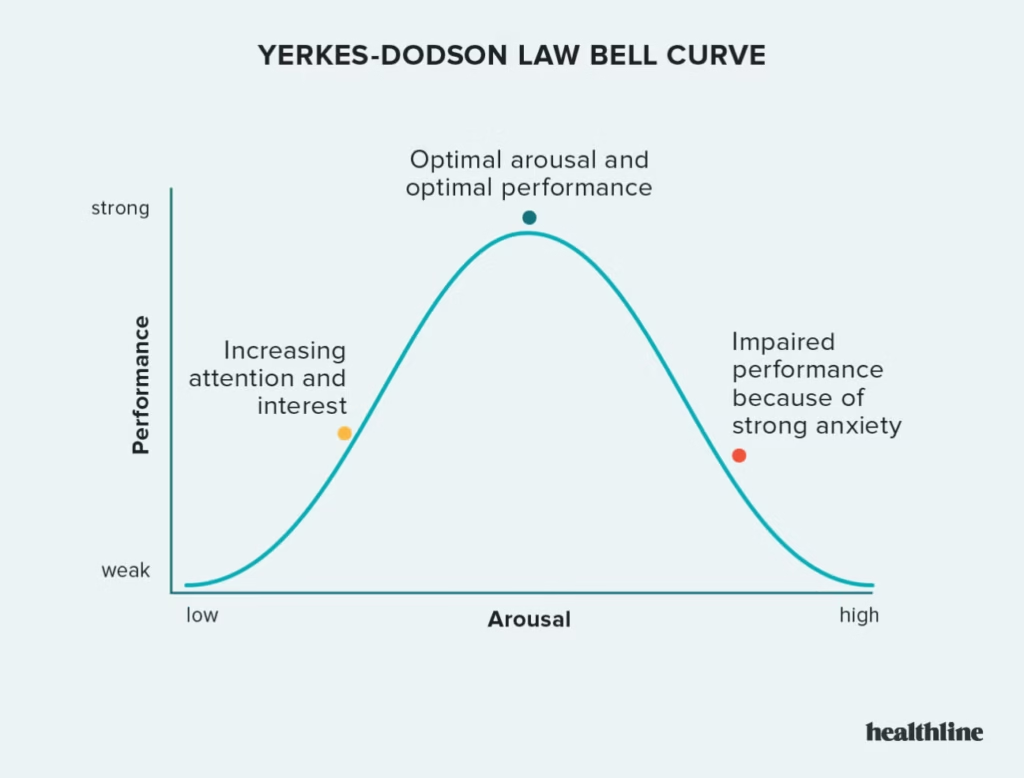
In 1908, Robert Yerkes and John Dodson published the results of an experiment that, by contemporary ethical standards, would not clear an institutional review board. They placed mice in a maze and used graduated electrical shocks to motivate performance, varying the intensity of the shocks and the difficulty of the discrimination task the mice were required to complete. What they found — that performance improved as shock intensity increased up to a point, then deteriorated as intensity continued to rise — gave rise to the inverted-U curve that has appeared on psychology textbook slides ever since.
The arc of that idea over the subsequent 116 years is a case study in how scientific findings travel through culture. The Yerkes-Dodson curve has been cited in support of management practices, athletic training protocols, educational design, and therapeutic interventions. It has been reproduced on whiteboards in corporate training rooms by facilitators who have never read the original paper. It has become one of those ideas that feels so intuitively right — of course there is an optimal level of pressure; of course too little motivation is as bad as too much — that its actual empirical content has become nearly irrelevant to its continued use.
This matters because the simplified version of the law, the one that gets reproduced most often, discards precisely the details that make it practically useful. What follows is an attempt to recover those details, to situate the original finding within what subsequent neuroscience and psychology research has established, and to say something concrete about what the curve can and cannot tell you about managing pressure in the real world.
The inverted-U is one of the most reproduced images in psychology — and one of the most systematically misrepresented. Its apparent simplicity is not a virtue. It is the mechanism by which important nuance disappears.
I. What the Original Experiment Actually Established — And What It Did Not
The first and most important caveat about the Yerkes-Dodson Law is one that is rarely stated plainly in secondary sources: the original data came from mice receiving electrical shocks, and the inferential distance between that experiment and any claim about human cognitive performance under psychological pressure is very large. This is not a reason to dismiss the law — it is a reason to hold the application to human contexts with appropriate epistemic modesty, and to evaluate which aspects of the original finding have been independently validated in human populations and which have been assumed rather than demonstrated.
The second finding in the original paper — consistently overlooked in popular treatments — is in many respects more important than the inverted-U itself. Yerkes and Dodson did not find a single universal curve. They found a family of curves whose shape varied systematically with task complexity. For simple tasks, the optimal arousal level was higher — meaning animals performed best under relatively intense stimulation. For complex tasks requiring fine discrimination, the optimal arousal level was lower — meaning the curve peaked earlier and descended more sharply as stimulation increased.
The practical consequence of this finding is directly applicable to decisions about how to structure performance environments. The question is never simply ‘how much pressure is optimal’ in the abstract. The question is always ‘how much pressure is optimal for this specific type of task.’ High arousal may enhance performance on tasks that are well-practiced, physically demanding, or require sustained output of a single well-learned skill. High arousal is almost invariably counterproductive for tasks requiring novel problem-solving, creative synthesis, nuanced judgment, or the management of competing considerations. A manager who applies uniform high-pressure tactics across an organization regardless of the cognitive demands of different roles has misread the law in its most fundamental respect.
II. The Neuroscience Behind the Curve: What Cortisol Does to the Thinking Brain
Contemporary neuroscience has provided the Yerkes-Dodson Law with a mechanistic foundation that Yerkes and Dodson could not have imagined in 1908. That foundation both validates the original observation and complicates it in ways that are practically significant.
The physiological substrate of arousal, at the neural level, involves primarily the hypothalamic-pituitary-adrenal axis and the central norepinephrine system. When the brain detects a significant challenge or threat, this system activates, triggering the release of cortisol and adrenaline. At moderate levels, these neurochemicals sharpen attention, improve information processing speed, and focus cognitive resources on the task at hand. This is the biological mechanism of the left side of the inverted-U — the region where increasing arousal produces improving performance.
The critical shift occurs when cortisol elevation becomes too high or too prolonged. Amy Arnsten’s research at Yale identified a specific mechanism: elevated cortisol activates alpha-1 adrenergic receptors in the prefrontal cortex, impairing the transmission of signals between neurons in this region. The prefrontal cortex — the part of the brain responsible for planning, judgment, impulse control, working memory, and abstract reasoning — becomes progressively less functional as arousal escalates past the optimal point. Simultaneously, the amygdala, the brain’s threat-detection and emotional processing center, becomes more dominant. This is not a metaphor; it is a documented shift in the relative activation of brain regions that has measurable consequences for the kinds of thinking a person is capable of performing.
The phenomenon most people have experienced as ‘going blank’ during a high-stakes examination, or ‘freezing’ during a critical presentation, is the experiential signature of this shift. The knowledge has not disappeared. The prefrontal cortex simply no longer has adequate resources to access and deploy it efficiently against a background of cortisol-induced noise. The person is not failing because they did not prepare; they are failing because the performance environment has triggered a physiological response that is optimized for escape from predators, not for demonstrating mastery of complex material.
Dopamine function in prefrontal circuits adds another layer of complexity. Optimal dopamine levels in the prefrontal cortex produce what neuroscientists call a favorable signal-to-noise ratio — the brain is alert enough to detect and respond to relevant information while filtering out irrelevant stimulation. This is the neural correlate of what Csikszentmihalyi describes as Flow: effortless concentration, a sense of being precisely matched to the demands of the task. Both too little dopamine (understimulation, boredom, fatigue) and too much (overstimulation, anxiety, distraction) degrade this ratio. The inverted-U is, at this level, a description of how dopaminergic function in the prefrontal cortex responds to varying levels of arousal.
III. Why the Same Pressure Destroys One Person While Elevating Another
The most practically significant limitation of the Yerkes-Dodson Law as typically presented is the implicit assumption that the curve is universal — that all individuals share roughly the same optimal arousal level for the same task. The research literature is unambiguous that this is not true, and the sources of individual variation are sufficiently well-understood to have direct implications for how performance environments should be designed.
Expertise is among the most powerful determinants of where an individual sits on the curve for a given task. Hans Selye, whose foundational work on stress biology was published in the same mid-century decades when Yerkes-Dodson was becoming a standard reference, observed that experienced practitioners in demanding fields could maintain high performance under conditions of pressure that would incapacitate novices performing the same task. The mechanism is cognitive automaticity: when a skill has been practiced to the point where it is largely processed at a non-conscious level, its execution no longer competes with the stress response for prefrontal resources. An experienced surgeon performing a familiar procedure under conditions of high arousal can draw on motor memory and pattern recognition that do not require the deliberate attentional resources that cortisol disrupts. A medical student performing the same procedure cannot.
The second major source of individual variation — less discussed but equally important in applied contexts — is the history of an individual’s relationship with controllable adversity. Research in developmental psychobiology has established that exposure to moderate, manageable stressors during development, particularly in the presence of supportive relationships, tends to calibrate the HPA axis toward more adaptive stress responsivity in adulthood. The system learns that arousal is survivable and manageable, which affects the threshold at which it transitions from eustress to distress. Conversely, histories of chronic, uncontrollable stress, particularly early in development, can produce a hypersensitive stress system in which the threshold for overwhelm is substantially lower than average. For such individuals, the optimal arousal zone on the curve is narrower, the curve descends more steeply past the peak, and interventions that would help a typical person reach their optimal arousal level may instead push them past it.
This has immediate implications for the kind of pressure applied in educational and organizational contexts. The question ‘why isn’t this person responding to the pressure I’ve created’ may have the answer that the person is already operating well to the right of their personal optimal arousal point — not at the left. No external behavioral signal reliably distinguishes between under-arousal and over-arousal; both can present as disengaged, unproductive, or unresponsive. The correct diagnosis requires knowing something about the individual, not just about the average curve.
IV. Flow, Eustress, and the Razor’s Edge Between Peak and Collapse
Csikszentmihalyi did not begin his research program on Flow with the Yerkes-Dodson Law as a reference point. His initial observations came from watching artists, chess players, rock climbers, and surgeons describe a particular quality of absorbed, effortless engagement that seemed to occur at specific conditions of challenge and skill. But when the theoretical structure of Flow is placed alongside the Yerkes-Dodson framework, the structural alignment is unmistakable. Flow occupies precisely the region that Yerkes-Dodson identifies as optimal arousal: the zone where challenge is sufficient to demand complete engagement but not so intense as to trigger threat responses.
Csikszentmihalyi’s specific contribution to the map is the insight that optimal arousal is not an absolute level but a ratio — specifically, the ratio of challenge to skill. The same objective level of task difficulty can produce Flow in a highly skilled practitioner, paralyzing anxiety in someone whose skills fall well below the task demands, and bored disengagement in someone whose skills substantially exceed them. This means that the optimal arousal zone shifts upward as skill develops: what was once optimally challenging becomes insufficiently stimulating once mastery increases. This is why the conditions that produce peak performance are not static — they require continuous calibration as the practitioner develops, and why effective coaches and teachers continuously adjust the difficulty of challenges rather than maintaining a single standard.
What neither Yerkes-Dodson nor Flow theory adequately conveys is the fragility of the peak. The smooth inverted-U curve creates a visual impression of a gradual transition — that the descent from optimal performance is a gentle slope one slides down gradually. The phenomenological reports of high performers in demanding domains tell a different story. The peak is not a plateau; it is a ridge. A single intrusive thought, a minor technical error that is noticed and interpreted as a harbinger of collapse, a moment of self-conscious awareness of being observed — any of these can trigger an abrupt transition from the right side of Flow to the right side of the Yerkes-Dodson curve. The biological mechanism is the amygdala’s capacity for rapid, wide-amplitude responses that can override prefrontal regulation with very little warning. Managing performance under genuine pressure is partly a matter of reaching the peak; it is equally a matter of preventing the disruptions that trigger the fall.
V. Eustress and Distress: Same Chemistry, Different Stories
Selye’s distinction between eustress and distress — between stress that enhances and stress that degrades — is one of the most conceptually important and practically underutilized ideas in the entire stress literature. The reason it tends to get lost is that the two states are physiologically similar in many respects: both involve cortisol release, both activate the sympathetic nervous system, both produce the familiar constellation of elevated heart rate, heightened alertness, and mobilized energy. The difference is not primarily biochemical. It is interpretive.
When you choose to run a race and feel your heart rate climb toward maximum effort near the finish, you are experiencing eustress — the cortisol and adrenaline are present, but the brain’s appraisal of the situation is one of challenge and chosen engagement. When an uncontrollable deadline approaches and you feel the same physiological response, the brain’s appraisal is one of threat and potential failure. The biochemistry overlaps substantially; the cognitive and behavioral consequences diverge dramatically.
Alia Crum’s research at Stanford has provided some of the most striking evidence for how consequential this appraisal difference is. In a series of studies, participants who were taught that stress has enhancing effects — that the physiological arousal of stress is the body preparing to meet a challenge — showed better cognitive performance, healthier cardiovascular profiles, and more constructive behavior under stress than participants taught that stress is damaging, even when the two groups experienced equivalent levels of physiological arousal. The implication is not that stress is always beneficial, or that distress should be minimized by cognitive reframing alone. It is that the appraisal layer between physiological arousal and performance outcome is a genuine intervention point — and one that is substantially more accessible than the physiological arousal itself.
This is the scientific grounding for why cognitive restructuring, mindfulness-based stress reduction, and similar approaches that work at the level of appraisal and meaning-making can have real effects on performance, not merely on subjective experience. They are operating on a variable that genuinely sits between the arousal state and the performance outcome in the causal chain.
VI. Practical Navigation: Finding and Sustaining Your Personal Optimal Zone
The practical section of most Yerkes-Dodson discussions tends to be the least useful part — typically concluding with advice to ‘maintain moderate arousal,’ which is accurate but as actionable as telling a sailor to ‘stay near the middle of the channel.’ What is more useful is a framework for knowing where you are on the curve at any given moment, and understanding which specific levers can move you in the direction you need to go.
The most reliable indicators of position on the curve are physiological rather than subjective, because subjective emotional states are often the last to accurately report a problem. Heart rate variability is among the best-validated: sustained high HRV is associated with autonomic flexibility and recovery, consistent with operating in or near the optimal zone. Sustained low HRV, particularly in the absence of acute physical exertion, indicates a nervous system running in a chronic defensive posture. Elite athletes, musicians, and performers in high-stakes domains have adopted HRV monitoring as a diagnostic tool for exactly this reason — not as a performance optimization curiosity but as a way of identifying when the nervous system is not in a state where demanding performance should be attempted.
For movement upward from the underperformance region — the left side of the curve — the most evidence-supported strategies involve controlled activation: music with strong rhythmic structure and personal associative significance, deliberate recall of past successful performances in the same domain, brief pre-performance affirmation protocols, and mild controlled hyperventilation through breathing patterns that shift sympathetic tone. These work by gently recruiting the stress response to move the nervous system from a state of low arousal toward optimal engagement.
For movement downward from the overperformance-into-collapse region — the steep right side of the curve — the evidence points in two directions simultaneously. Physiologically, extended exhalation activates the parasympathetic nervous system more directly than any other volitional behavior; the box breathing and 4-7-8 protocols used by high-performance communities are not mystical but mechanistic. Cognitively, reappraising the situation — moving from a threat framing to a challenge framing, from ‘I must not fail’ to ‘this is the occasion to deploy what I have prepared’ — has demonstrated effects on downstream physiological arousal that go beyond subjective report, measurable in cortisol levels and cardiovascular function.
Conclusion: Your Personal Curve Is Something No Textbook Can Draw for You
The Yerkes-Dodson Law is among the small number of early twentieth-century psychological findings that have retained serious scientific relevance, not because the original formulation was correct in every detail, but because it identified a genuine structural feature of the relationship between physiological arousal and performance that subsequent research has confirmed, refined, and extended rather than refuted. The neuroscience of cortisol and the prefrontal cortex has provided its mechanism. Flow theory has expanded its scope to encompass the role of skill and the phenomenology of optimal performance. Stress appraisal research has added an interpretive layer between arousal and outcome that the original model did not contain.
What none of this literature can provide is a calibrated personal map. The curve shifts with expertise, with the history of your relationship with adversity, with sleep, with age, with the specific domain of performance. The same individual will have meaningfully different curves for a well-practiced skill and a novel challenge, for a performance observed by a critical audience and one conducted in private, for work performed immediately after a significant success and work performed in the shadow of a recent failure.
The inverted-U gives you a language and a framework. Learning to navigate your own version of it, in the specific terrain of your own life and work, is the project that no curve on a slide can complete for you.







◉ 0 Thảo luận Khoa học