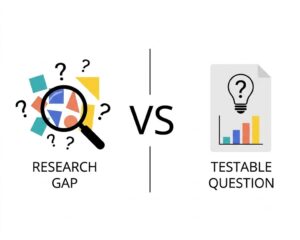

How to write a research proposal well is less about sounding impressive and more about turning a research problem into an assessable plan: a clear question, a defensible gap, an appropriate method, a meaningful contribution, and a feasible scope. This guide is designed for master’s, PhD, and research-scholarship applicants.
What is a research proposal?
A research proposal is a structured plan for a proposed study. It normally explains the research problem, questions, position in the existing literature, methodology, expected contribution, and practical plan. For many research degrees, it is a key document used to evaluate research potential, intellectual fit, and feasibility.
There is no single international word count or universal template. The University of Manchester notes that typical proposals may be around 1,000–1,500 words, while individual Schools set their own requirements. Oxford’s graduate application guidance similarly tells applicants to follow the exact specifications on the relevant course page.
1. Before writing: check the programme’s exact requirements
- Is a full proposal required? Some science programmes recruit into existing projects and may ask for a statement of interests instead.
- What is the word/page limit? Never submit a 3,000-word document where the limit is 1,500.
- Which sections are compulsory? Requirements may include research questions, literature, methods, ethics, timetable, supervisor fit, and bibliography.
- Do you need to name or contact a supervisor? Practices differ by department.
- What is the AI policy? Rules now vary sharply. For example, Saïd Business School states that DPhil Management applicants must not use generative AI to produce their research proposal. Manchester likewise stresses original, independent academic thinking.
2. What do assessors usually look for?
Across official guidance from Oxford and Manchester, recurring criteria include clarity, coherence, originality, command of the literature, methodological quality, feasibility, reasoning, and fit with the research environment. The Oxford Internet Institute, for example, asks for an indicative title, synopsis, relevant literature, a research question or hypothesis, and a proposed methodological approach.
| Criterion | What a strong proposal shows | Common weakness |
|---|---|---|
| Research question | Specific, researchable, academically meaningful | Too broad or slogan-like |
| Literature & gap | Understands the debate and identifies an unresolved issue | Article-by-article summary without synthesis |
| Methodology | Data, sampling, instruments and analysis fit the question | Names a method without explaining execution |
| Contribution | Explains the theoretical, methodological or practical value | Generic claims that the topic is “important” |
| Feasibility | Scope, access, ethics, time and resources are realistic | Project is larger than the degree can support |
| Research fit | Matches faculty, lab or supervisor expertise | A good topic with no credible supervisory home |
3. An 8-part research proposal structure
Part 1. Working title
Your title should communicate the population/object + problem or relationship + context. Avoid labels so broad that the reader cannot infer the research design.
Part 2. Abstract or proposal summary
If required, write this last. In a compact paragraph, state the problem, research question, proposed method, and expected contribution. Do not claim more than the design could reasonably establish.
Part 3. Background and problem statement
Move from the broad context to the precise problem. End with a focused statement of what remains unknown, why that matters, and what consequence follows from leaving the problem unresolved.
Part 4. Research questions, objectives and hypotheses
Every question should be answerable with the evidence you can realistically collect or analyse. If you use hypotheses, connect them to explicit constructs or variables and to the planned analysis.
Part 5. Literature review and research gap
A proposal literature review is not a reading log. Organise the literature by debates, themes, methods, theories or findings. Show where studies converge, where they conflict, and what remains insufficiently explained. A gap matters only when it leads to a worthwhile research question.
Part 6. Methodology
Explain how the study would actually work. Depending on the field, clarify:
- research design;
- population, cases or data sources;
- sampling/access strategy;
- data collection instruments;
- variables, coding framework or analytical model;
- analysis techniques;
- validity, reliability or trustworthiness strategy;
- ethical, consent, privacy and data-management considerations.
Part 7. Expected contribution and significance
Specify whether the study may test or extend theory, provide evidence in an understudied context, improve a method, create a dataset/tool, or generate defensible implications for policy or practice.
Part 8. Timeline, feasibility and references
Show that you understand the sequence of research: literature and design, ethics approval, data collection, analysis, writing, revision and dissemination. References should prioritise field-defining and directly relevant recent scholarship.
4. The Question–Method–Contribution triangle
- Question: What exactly do you want to know?
- Method: What evidence and analysis can answer it?
- Contribution: If answered, what changes in knowledge or practice?
If one side does not align, the proposal weakens. A cross-sectional survey, for example, should not be used to make strong causal claims unless the design contains a credible identification strategy. Likewise, a descriptive design should not promise to test a complex causal mechanism that it cannot observe.
5. Find a research gap with a synthesis matrix
A good gap is not necessarily a topic that nobody has ever studied. It may be an unresolved contradiction, a methodological limitation, missing evidence in a relevant population, or an untested theory in a substantively different context.
| Study | Context/sample | Method | Main finding | Limitation | Opportunity |
|---|---|---|---|---|---|
| Study A | University sample in country X | Cross-sectional survey | A is associated with B | Mechanism not tested | Add mediation or longitudinal design |
| Study B | Small discipline-specific group | Interviews | Three recurring themes | Limited transferability | Test across disciplines or with a broader sample |
| Study C | International context | Mixed methods | Contradicts Study A | No Vietnam evidence | Test institutional/cultural context as an explanation |
After mapping 10–20 core sources, look for repeated patterns rather than copying the “future research” sentence from one paper. The strongest gap usually sits at the intersection of an important problem, insufficient evidence, and a design you can realistically execute.
6. Master’s vs PhD research proposal
| Dimension | Research Master’s | PhD |
|---|---|---|
| Scope | Narrow and manageable | Deeper and capable of a substantial original contribution |
| Literature | Shows command of foundations and major debates | Positions the project at the current research frontier |
| Methods | Appropriate and feasible | Requires stronger justification and treatment of limitations |
| Contribution | May extend evidence or solve a bounded applied problem | Should demonstrate plausible novelty for the field |
| Supervisor fit | Important | Often critical for a multi-year research programme |
7. Compact research proposal template
Working title: [population/object + issue/relationship + context]
Problem statement: [2–4 sentences on the unresolved problem and why it matters]
Research question: [one main question] + [up to 1–3 sub-questions if needed]
Literature positioning: [main debates, agreements, contradictions and limitations]
Research gap: [a precise, meaningful unresolved issue]
Method: [design] – [sample/data] – [collection] – [analysis] – [ethics]
Expected contribution: [theoretical/methodological/practical]
Timeline: [major phases and milestones]
References: [core scholarly sources]
A 120-word example outline
This study examines the relationship between AI literacy and academic-integrity practices among postgraduate students in Vietnam. It asks whether the ability to evaluate AI-generated outputs is associated with stronger recognition and avoidance of inappropriate AI use. A mixed-method design will combine a survey with semi-structured interviews to estimate the relationship and explore the reasoning behind students’ decisions. The study is expected to address a contextual evidence gap in Vietnam and to inform institution-level guidance for responsible AI use in postgraduate education. The design will explicitly distinguish association from causation and will include appropriate consent and data-protection procedures.
8. Eight common mistakes
- Overly broad scope.
- A superficial gap: “nobody studied city X” without explaining why X changes the problem.
- Laundry-list literature review.
- Vague methods: no sample, data, instrument or analysis plan.
- Question–method mismatch.
- Overclaiming contribution.
- No evidence of supervisor or departmental fit.
- Ignoring submission rules, including AI or integrity policies.
9. 15-point checklist before submission
- □ I read the official requirements for the exact programme.
- □ My title communicates object/problem/context.
- □ The problem statement leads directly to a research question.
- □ The question is answerable with the proposed design.
- □ The literature review synthesises rather than lists.
- □ The gap is meaningful, not merely “unresearched”.
- □ I justify why the method fits the question.
- □ Data access and sampling are realistic.
- □ Ethics, privacy and data management are addressed where relevant.
- □ The expected contribution does not exceed the evidence the study can produce.
- □ The timeline fits the programme.
- □ The project fits the department/supervisor.
- □ References prioritise core and recent scholarship.
- □ I comply with the institution’s AI and academic-integrity rules.
- □ I edited for clarity, concision and consistent terminology.
10. Frequently asked questions
How long should a research proposal be?
There is no universal length. Manchester gives 1,000–1,500 words as a typical range in its general guidance, but departments and universities can set very different limits. Follow the official programme page.
Does a research proposal need an abstract?
Only if the programme asks for one or if the disciplinary convention makes it useful. Otherwise, a concise overview may be enough.
Does a research gap have to mean “nobody has studied this”?
No. A gap may be contradictory evidence, a methodological weakness, a missing population, or an untested theoretical explanation.
Should I contact a professor before applying?
It depends on the programme. Some departments encourage early contact with a potential supervisor; others use a different allocation process. Check the official instructions.
Can I use AI to write my proposal?
Do not assume that you can. Policies differ, and some programmes explicitly prohibit generative AI for application materials. Your final submission must comply with the programme’s rules and represent your own academic reasoning.
Key references
- University of Oxford – Research proposal guidance
- Oxford Internet Institute – DPhil application requirements
- Saïd Business School – DPhil Management application requirements
- University of Manchester – How to write a research proposal
- Manchester School of Social Sciences – Writing your proposal
- The University of Queensland – How to write a research proposal for your PhD
Next step on Vietnam ScholarHub
Once your question, method and contribution are aligned, you can explore relevant scholars on the VSH Scholar Network and compare current opportunities through the VSH Scholarships & Academic Opportunities portal.