
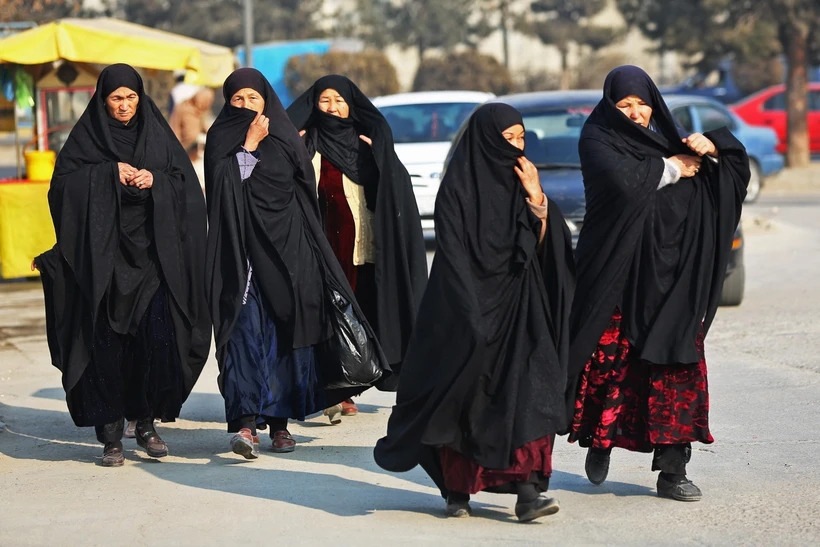
I began researching Afghan women not from statistics, but from a simple and haunting question: what would happen to me if I had been born there?
This might sound naive, even self-centered. But I believe it is the truest starting point for empathy. Before we can act for someone, we must feel the weight they are carrying.
And that weight—for millions of Afghan women since August 2021—is so heavy that it cannot be understood from human rights reports alone.
- “You Cannot Go to School Anymore”
The story I remember most is not of a politician or a famous activist, but of a 14-year-old girl in Herat province whose account I read in Amnesty International documents. On the morning her school was closed, she had already put on her uniform and packed her bag. When she heard the news, she simply sat on the floor and wept—not in anger, not in fear, but with a cold understanding that her future had just been sealed shut.
In 2021, over 1.4 million girls across Afghanistan experienced that moment. According to UNESCO, this is an unprecedented event in modern history: the first time a country officially banned one gender from education beyond primary school.
Let us try to understand what this means. Not a lack of schools, teachers, or funding—the developmental tragedies many poor countries face. This is an intentional, carefully drafted ban, enforced with violence. A girl who dares attend class can be beaten; her family can be punished.
“If you want to control a people, start by controlling what women are allowed to learn.”
- The Number 0% and What It Means
I study political science. And in political science, some numbers change the way you see the world.
One such number is 0%—the rate of female representatives in Afghanistan’s parliament from September 2021. Just months earlier, that figure stood at 27.9%—higher than many Western democracies.
We are not talking about a decline from 27.9% to 20%, or 15%, or even 5%. We are talking about a decline to zero. Complete. Absolute.
This means that in the country’s highest legislative body, there is no woman’s voice. No one to speak against new bans as they are issued. No one to question the impact of policies on the lives of half the population. In political theory, we call this systematic exclusion. When you remove a group from decision-making, you ensure their interests will never be protected by that system. This is not accidental—this is design.
III. The Economics of Control
There is a question few ask: why did the Taliban ban women from working? From a purely economic standpoint, this decision is bewilderingly irrational. Afghanistan is in severe economic crisis: 48% of the population lives below the poverty line, food is scarce, international aid is cut. In that context, banning half the potential workforce from working—especially women performing irreplaceable healthcare and humanitarian roles—is self-destructive.
But that is if you look through an economic lens. Through a lens of power, the logic becomes clear: a woman without income is a woman completely dependent. Economic dependence creates social dependence, creates physical dependence. And physical dependence—the ability to move, to survive—ultimately creates silence. This is the economics of control. And the Taliban has applied it systematically.
“When you take away a woman’s work, you don’t just take her income. You take her voice.”
- When Religion is Used as a Weapon
I want to be direct about this, because I believe it is one of the greatest misconceptions in international media coverage of the Taliban: what the Taliban is doing is not Islam.
This is what moderate Islamic scholars—from Turkey to Indonesia, from Malaysia to Morocco—have consistently affirmed. Turkish Foreign Minister Mevlut Cavusoglu directly stated: ‘What is wrong with educating women? Is this Islamic law? Absolutely not!’
The Taliban is using religion as a political weapon—selecting passages out of context and constructing a system of control disguised as sacred morality. And this is precisely why the most effective resistance, in my view, must come from within the Islamic community itself—from scholars who have the courage to say: this is not our faith.
- Comparison, Not Complacency
When I compare the situation of Afghan women with Vietnam, I do not do so to be self-satisfied or to praise my country unconditionally. I do it because comparison is the best way to understand what is ‘inevitable’ and what is ‘political choice.’
Vietnam: 30% of National Assembly delegates are women. Afghanistan: 0%. Vietnam: women constitute 61.6% of the labor force. Afghanistan: 4.8%. These differences do not stem from geography or climate. They reflect policy choices, institutional investments, and above all—the values a society decides matter.
But I also want to be honest: Vietnam is not perfect. Formal gender equality and substantive gender equality are two different things. In many Vietnamese families, the idea that ‘housework is women’s work’ persists. Early marriage still occurs in many rural and ethnic minority areas. Domestic violence is still underreported. The gap between law and reality is a problem every society is working to close.
- What the World Owes Afghan Women
I remember the strong statements from world leaders after the Taliban’s December 2022 ban on women attending universities. The EU called it ‘crimes against humanity.’ The US promised ‘consequences.’ Fifty-seven Islamic countries in the OIC condemned it. And then… nothing happened.
I say this not out of cynicism, but because I think there is one thing the international community can do better: not let the Afghan story be forgotten. Every month, every year that passes, news about Afghanistan fades from headlines. Journalists move on to newer crises. NGOs must redirect resources to ‘hotter’ zones. But for millions of Afghan women and girls, time does not stop. Every day without school is a day lost forever.
“We cannot afford to grow tired of a crisis simply because it has lasted too long.”
VII. What This Research Has Taught Me
This research changed me in ways I did not anticipate. It taught me that freedom is not natural—it must be built, defended, and sometimes reclaimed. That the rights I enjoy—to learn, to work, to travel alone—are not self-evident everywhere in this world.
It taught me that gender equality is not ‘a women’s issue’—it is a question of development, social stability, and human dignity. A society cannot develop sustainably when half its potential is imprisoned.
And it taught me that academic research, however important, has real value only when it connects to action—to speaking up, to sharing, to refusing to look away when someone is being stripped of their basic human rights.
The story of the 14-year-old girl in Herat, sitting on the floor weeping because she could not go to school—that story should not be forgotten. And if these pages add one small voice to their struggle, that is the deepest hope I have for this work.




◉ 0 Thảo luận Khoa học